January 21st, Day 16

Today we drove from Sigiriya to our sixth and final destination, Hambantota. What was supposed to be a seven-hour drive stretched into nearly 11 hours as we chose to avoid the highway due to warnings of rockfalls and temporary road closures.

In this long journey we observed the big contrast of religious temples and churches and the general infrastructure and house of the people. It seems as if the after life is more important than the present. We could also see that Sri Lanka is an agricultural country by the vast endless rice fields, coconut and palm tree plantations.

One of the culture's shocking moments through the journey was seeing people driving vehicles without shoes. Straight up feet and toes! In contrast to Norway and other western countries, we observe that in Sri Lanka, people are more dependent on selling products that are handmade or produced in their farm, such as fruits, vegetables and souvenirs. The consequence of this is economical dependency on tourists or other markets. Furthermore we believe the workers have poor working conditions and low wages.

After 10-hours we arrived at Lake Villa Resort and were served Western cuisine - a small but comforting taste of home.

Group 4 - Venera, Oliwia, Any and Kaja
January 19, Day 14

Today we left Jaffna at 9.30 and drove South to Sigiriya. Since our bus is still getting fixed, we had to take two minivans. Even though it is dry season here in Sri Lanka, we experienced a lot of rain during the drive. Throughout the drive, we drove past a lot of flooded areas. We also drove past a lot herds of cows.

We arrived at Sigiriya about 3 o’clock, where we stopped at a restaurant to eat lunch, and got served rice and curry. After lunch we drove to the Hotel we are going to stay at. Our hotel has a view to the Sigiriya rock. The Sigiriya rock has a citadel on the top, build by King Kasyapa who ruled from 477 to 495 AD. It became an UNESCO world heritage cite in 1982. The rock is 200 meters high, and well known by tourists, who come from all around the world to get a glimpse of the rock. You can climb the 1200 steps to the top to get a nice view of the current area. Before dinner we all had a meeting and an evaluation of the trip so far, where The Head of our Department, Morgan, joined us. We ended the day with dinner from the nearby resturants.

Group 2: Emma, Jenni, Leah, Karoline

January 15th, Day 10

enter image description hereToday, we traveled from Kandy to Anuradhapura, the ancient capital of Sri Lanka. The drive became a bit cramped, as we had to replace our large bus with two vans.
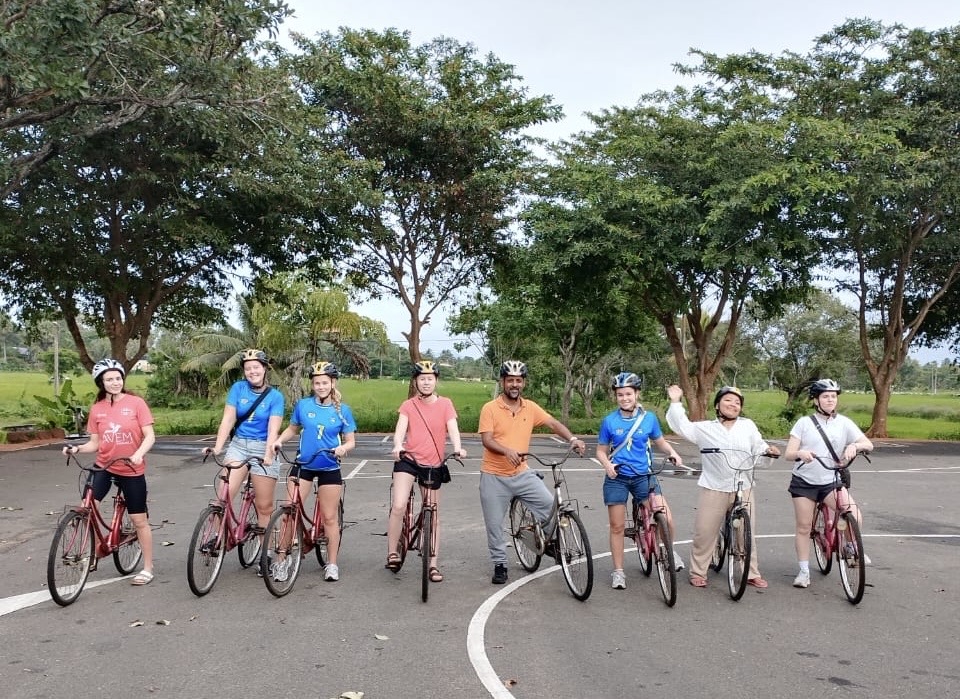
After nearly five hours on the road, we finally arrived at Sadula Holiday Resort where we will stay for the next two nights. Further, we started exploring the city’s historic sites. Some of us did it by one of the vans, while others chose to cycle.

enter image description here

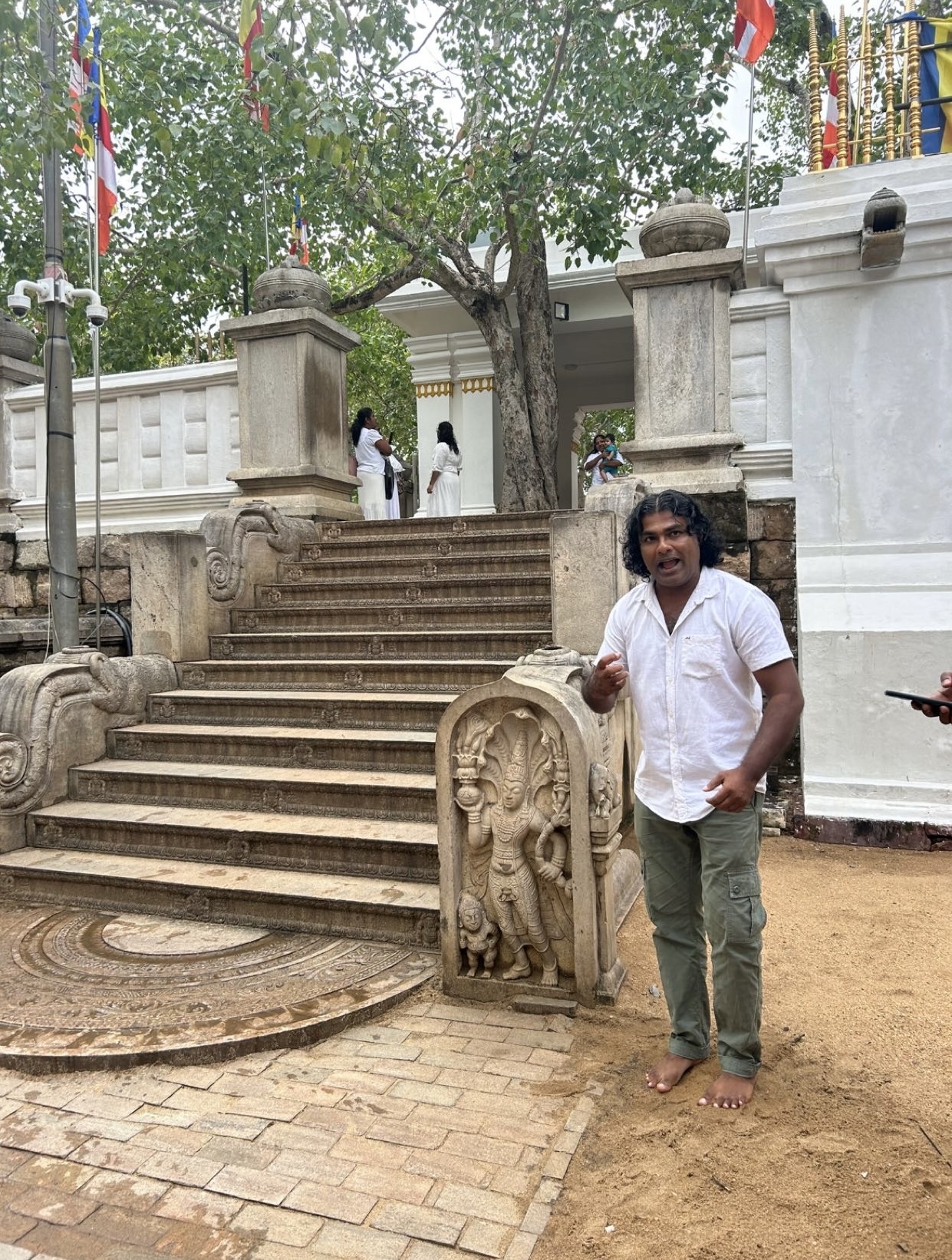
Our first stop was the sacred Jaya Sri Maha Bodhi, a fig tree believed to be a sapling from the original Bodhi tree under which Buddha attained enlightenment. Planted in 288 BC, it is considered the oldest living human-planted tree in the world with a known planting date. Our guide also gave us a brief introduction to Buddhism. For example, he talked about how reincarnation and karma are connected, and how what we do in this life can affect our future lives. He also explained that the goal for Buddhists is to achieve nirvana, a state of freedom from suffering and desire.

The guide showed us many lilies layed out and explained that they symbolize purity and are used as offerings to the Buddha. He mentioned that water lilies are also the national flower of Sri Lanka. Following tradition, we walked clockwise around the ancient fig tree, a gesture believed to bring good luck.

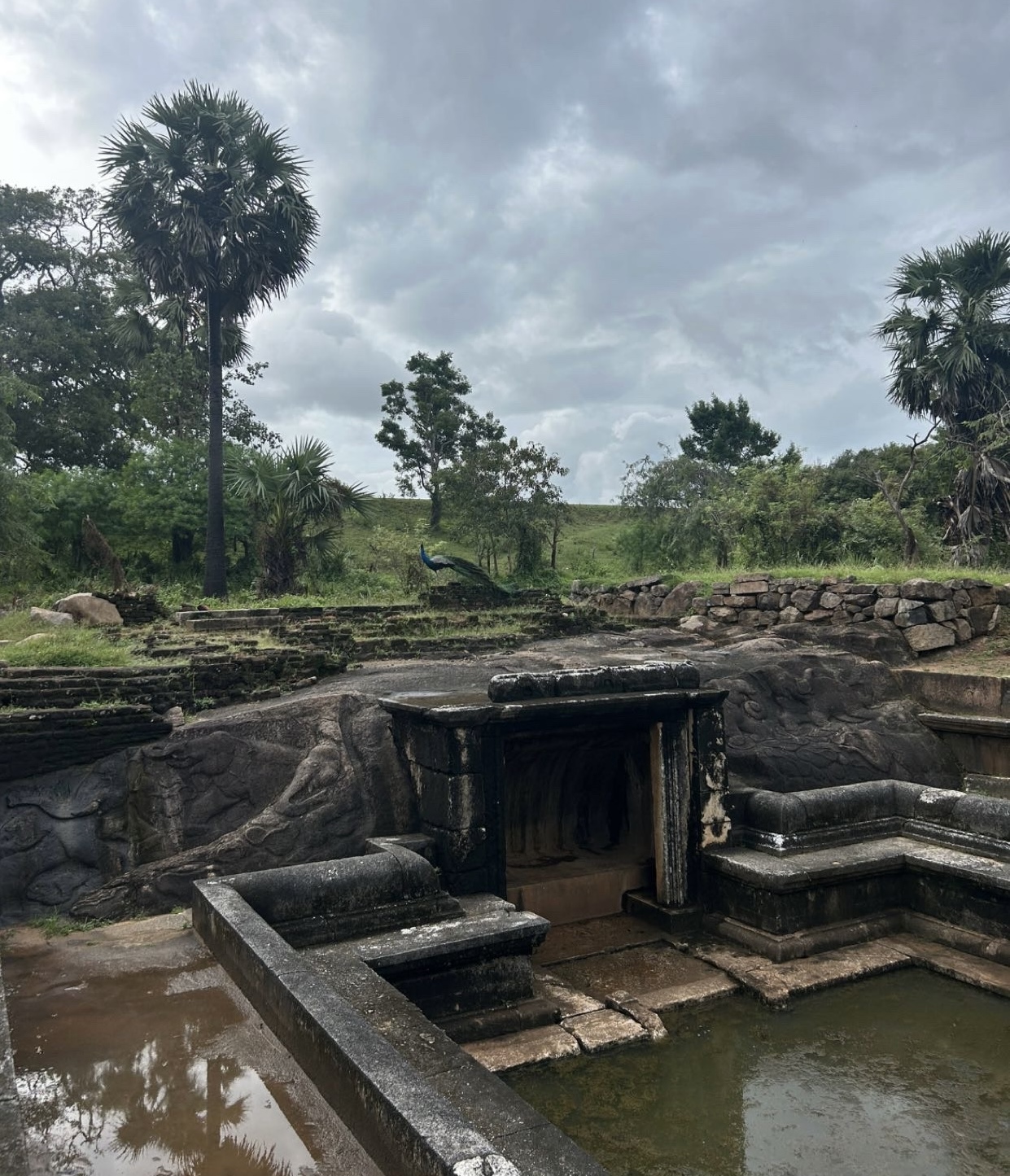
Further, we visited the Kuttam Pokuna, or Twin Ponds, remarkable examples of ancient Sinhalese engineering. These pools were used by monks for ritual baths and showcase the advanced hydrological knowledge of the time.

Anuradhapura, established around a cutting from the ‘tree of enlightenment’ brought there in the 3rd century B.C., was a political and religious capital that flourished for 1,300 years before being abaundoned after an invasion in 993. Hidden away in dense jungle for many years, the splendid site, with its palaces, monasteries, and monuments, is now accessible once again.

enter image description here

Group 4 - Venera, Oliwia, Any og Kaja

Second day in Sri Lanka, January 7th

Today, january 7th, we left at 9 am to spend a few hours in the university of Ruhuna, where we learned about the economy of Sri Lanka. The lecture was held by Dr. Sumanarathna, where he explained that Sri Lanka had an economic crisis and not a financial crisis. The normal salary to make in a year is approximately 50 thousand kroner, which is 1.3 million rupi’s.

Later we drove about one hour to visit a fabric factory called Miami Exports, located in Ranna. We learned a lot of interesting things about the process of making clothes. When the fabric arrives at the factory, it has to be pressed so it is nice and without wrinkles, then it is placed in shelves where they have different places for different colors and the fabric type. The fabric has to go through different stages before it can be sown into clothes. After the long process, it goes through different stations where different people make different parts of the product, some fix the waistband, others work on the stitching around the neck.

We also learned that there are approximately 1200 employees, where the age goes from 18 all the way up to 50. The worker here typically work 10 hours a day. The factory have two different stations where the buildings are packed with workers. When walking inside the buildings, we could se that the majority of the workers were women.

Group 2 - Karoline, Jenni, Leah, Emma

First day in Sri Lanka, January 6th

We left the hotel at 9 am to visit the University of Rahuna, a partner school to UIA. Although the structure itself was old, it was upkept with agricultural features such as the rock formations, trees, flowers, and lakes. We were welcomed by some from the school’s administration, including the vice chancellor, before we were taken into one of their conference rooms. We got to ask questions about the university life, including the gender imbalance and living accommodations. Surprisingly, we learned that the ratio was 80%-20% where the women represent the 80%. Similar to Norway, many students live in dormitories on the campus, and eat subsidized food in the cafeteria.

This was our first day the university of Ruhuna, were we got a little tour of the buildings and got to meet some of the professors and staff. Our first meal at the university was a traditional Sri Lankan morning snack and tea in the administration cafeteria. After this, we went on a short bus trip to the most southern tip of the island, where we also got to see the rebuild after the 2004 tsunami. On our way back to the university, Ajith gave us some knowledge about the domestication of elephants in Sri Lanka.

This would later be brought up in the lecture by professor Kumara when he discussed the ecological situation of Sri Lanka. Professor Kamara highlighted the vast biodiversity on the island and the subsequent geopolitical situations. As it turns out, the biodiversity contributes to the tourism industry due to bird watching opportunities.

Group 1 - Andrea, Julia, Kaja and Lorelei